
posted 4th September 2026
LOLER Inspection Frequency: Is It Every 6 or 12 Months?
If your business uses lifting equipment, one of the most common questions surrounding LOLER is simple: how often does a LOLER inspection need to be carried out?
The answer is not always 12 months, and it is not always 6 months.
Under the Lifting Operations and Lifting Equipment Regulations 1998 (LOLER), the required interval depends on the type of lifting equipment, what it is being used for and, in some circumstances, whether a written examination scheme has been established by a competent person.
Understanding the correct inspection frequency is essential for businesses responsible for lifts, cranes, hoists, lifting accessories, vehicle-mounted lifting equipment and other lifting equipment.
How often does LOLER require lifting equipment to be examined?
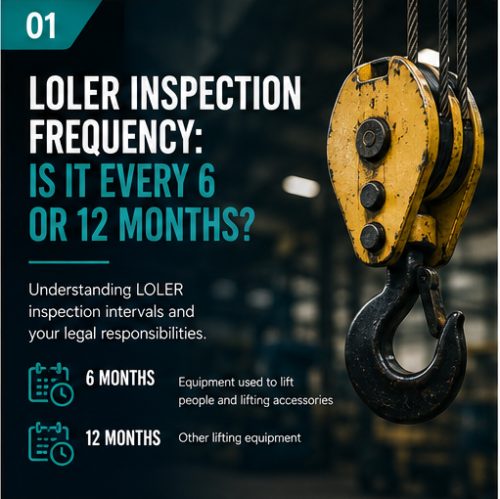
As a general rule, LOLER provides two standard examination intervals:
Every 6 months:
- Lifting equipment used to lift people
- Lifting accessories
Every 12 months:
Other lifting equipment used to lift or lower loads
A competent person may also establish an examination scheme which specifies different examination intervals where this is appropriate based on the equipment, its use, environment and associated risks.
These are maximum intervals under the standard LOLER arrangements, rather than a recommendation that equipment should simply be examined once a year.
What lifting equipment requires a 6-monthly LOLER examination?
Equipment used to lift people generally falls within the six-monthly requirement.
Examples can include:
- Passenger lifts
- Platform lifts
- Stair lifts
- Patient lifting equipment
- Certain hoists used to lift people
- MEWPs and other personnel-lifting equipment
- Other equipment specifically designed or used for lifting people
Lifting accessories are also normally subject to examination every six months.
This includes equipment such as:
- Chain slings
- Wire rope slings
- Webbing slings
- Shackles
- Eyebolts
- Lifting hooks
- Lifting beams and similar accessories
- Other accessories used to attach, support or secure a load for lifting
It is important not to assume that because the main machine has a 12-month examination interval, everything attached to it does as well.
For example, a business may have a lifting machine examined annually while its lifting accessories require separate six-monthly thorough examinations.
What equipment requires a 12-monthly LOLER examination?
Other lifting equipment is generally subject to a maximum examination interval of 12 months, unless an examination scheme specifies otherwise.
Examples can include:
- Cranes
- Overhead cranes
- Goods lifts
- Hoists used for lifting loads
- Vehicle-mounted cranes
- Lorry loaders
- Certain telehandlers
- Forklift trucks
- Vehicle lifts
- Other lifting equipment used to lift or lower loads
The exact application of LOLER should always be considered based on the equipment's intended use and configuration.
Does LOLER always mean 6 or 12 months?
No.
LOLER allows for an examination scheme prepared by a competent person.
An examination scheme can specify examination intervals appropriate to the particular equipment, its environment, its use and the risks associated with it.
This is particularly relevant where equipment is used intensively, exposed to harsh conditions or has characteristics that mean a different examination frequency is appropriate. HSE guidance recognises that different parts of lifting equipment may also require examination at different intervals.
The important point is that an alternative interval should not simply be chosen by the equipment owner because it is more convenient or cheaper. It needs to be properly established by a competent person.
What about inspections after an accident or damage?
The normal six- or twelve-month examination interval is not the only time a thorough examination may be required.
LOLER also makes provision for thorough examinations following exceptional circumstances that could jeopardise the safety of the equipment.
Examples can include:
- An accident
- Significant damage
- Major modification
- Changes affecting the equipment's safe operation
- Other circumstances that could affect safety
In these circumstances, waiting until the next scheduled examination may not be appropriate.
Don't confuse LOLER with routine inspections
A LOLER thorough examination is not a substitute for the routine checks, maintenance and inspections required during the normal use of equipment.
LOLER places wider duties on those responsible for lifting equipment, including ensuring that lifting operations are properly planned and that equipment is suitable and safe.
HSE guidance also explains that lifting equipment may be subject to both LOLER and PUWER requirements.
What should businesses do?
The first step is to identify every item of lifting equipment and lifting accessory within your organisation.
For each item, you should establish:
- What the equipment is
- What it is used for
- Whether it lifts people or loads
- Whether it is a lifting accessory
- The applicable examination frequency
- The date of the last thorough examination
- The next examination due date
- Any defects or recommendations recorded on previous reports
For businesses operating multiple sites or large quantities of lifting equipment, maintaining an accurate LOLER register can make a significant difference to compliance.
Need help with your LOLER inspection schedule?
Cert Safe Inspection Services provides LOLER thorough examinations for businesses across High Wycombe, Buckinghamshire, Oxfordshire, Berkshire and surrounding areas.
We inspect a wide range of lifting equipment and accessories and can help businesses establish a practical inspection schedule across individual sites or larger equipment portfolios.
If you're unsure whether your equipment is due for a six-monthly or twelve-monthly examination, get in touch with Cert Safe Inspection Services and we can help you establish the appropriate inspection requirements.
Key takeaway
The simple rule is:
6 months – equipment used to lift people and lifting accessories.
12 months – other lifting equipment.
Examination scheme – where a competent person has established an alternative interval appropriate to the equipment and its risks.
Getting the frequency right is an important part of maintaining LOLER compliance.